
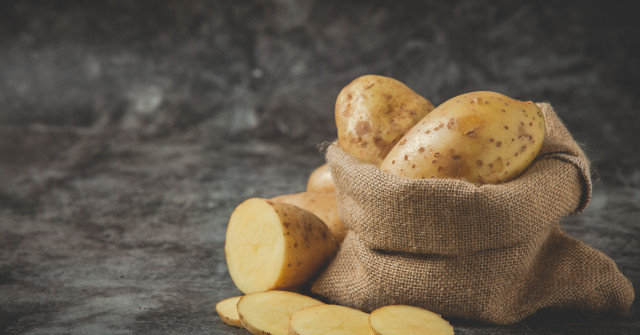
Potatoes
Columbus discovered America in 1492, and in the years that followed the Spanish set out across the New World in search of gold. In 1536 the Spanish conquistadors arrived at the Peruvian village of Sorocote and tasted potatoes for the first time. In 1570 they brought potatoes home to Spain.
From Spain, potatoes reached Italy, where they were initially called "tartufolo" from the word tartufi, meaning truffles, because of their knobby shape resembling mushrooms.
Initially potatoes were considered inferior food, and were the main food given to prisoners of war and to livestock. They were also considered poisonous, because the upper parts of the plant do indeed contain a toxin called solanine.
A French pharmacist named Antoine-Augustin Parmentier was captured in the Franco-Prussian War and spent seven years in a German prison camp. The main food there was potatoes. To his surprise, those who agreed to eat the potatoes came out of the war in excellent health.
Upon returning to France, Parmentier decided to launch a private marketing campaign for potatoes, which could save the poor of France from death by starvation. He began with parties for celebrities, at a banquet he held in the courtyard of Louis XVI and Marie Antoinette, a banquet that was entirely themed around the potato. The guests were decorated with the plant's flowers, and all the dishes served contained potato tubers in various variations.
Parmentier cultivated a large field with experimental crops of potato varieties and posted guards around it. Ostensibly, this was to prevent the theft of professional secrets; in fact, the guards were posted in such a way that allowed farmer thieves to sneak into the mysterious field under the cover of darkness, with Parmentier's deliberate encouragement, and steal the forbidden fruit. Thus the most maligned crop became a hot and tasty hit.
From France, potatoes spread to the rest of central Europe, such as Germany and Austria.
Potatoes continued to spread in the 18th century, and because they grow easily even in cold climates, they also reached northern Europe, to the Scandinavian countries.
And as their popularity grew, their standing among the aristocracy declined. The tubers became inferior food, symbolizing poverty and destitution.
But the most significant conquest of potatoes was in the British Isles, by Sir Francis Drake, Queen Elizabeth's royal pirate, who raided a cargo of potatoes from Spanish ships he attacked, which were making their way from the West Indies (the Caribbean region) to Europe.
In Great Britain too, the tubers met with difficulties in acceptance. The Scots, for example, imposed a strict ban on eating them because they are not mentioned in the Bible. Some avoided eating them due to a rumor that love potions could be brewed from them, and therefore they were unfit for modest and God-fearing people.
But the Irish, who lived under English occupation, had no choice. There, severe famine was frequent. Sir Walter Raleigh, an explorer of lands in the service of Queen Elizabeth, proposed at the beginning of the 17th century planting potato fields the length and breadth of Ireland. And potatoes became the main, almost exclusive, source of food in Ireland.
Because the potato has several advantages: its yields flourish in any weather; it is nutritious, its edible part grows beneath the ground, and it is not damaged by the crushing boots of British occupation soldiers. In 1815, two-thirds of Ireland's population made a living and fed themselves on potatoes. Following the potato's exclusivity in Ireland, when a deadly fungus struck them in 1845, the food source of an entire nation was almost completely destroyed, and about a million Irish died of starvation. This led to an unprecedented emigration to the New World, and the wave of Irish settlers in the second half of the 19th century is what was responsible for the settlement boom in the western United States.
The irony is that following the emigration of the Irish to the New World, the potato, beloved by the Irish, made a U-turn of sorts. Potatoes born in South America now reached the north, although the varieties that thrived in the 19th century were not similar to their Peruvian ancestors.
Until the arrival of the Irish, North Americans too regarded the potato with contempt or suspicion. In 1621, Captain Nathaniel Butler, governor of Bermuda, brought a gift to Francis Wyatt, governor of Virginia: two elegant wooden boxes containing potatoes and other exotic vegetables. The gift was received with cold politeness and thrown into the stables.
With the arrival of the Irish, potatoes began to be grown commercially in Idaho. Today Idaho is considered the potato capital of the United States.
The first alcohol made from potatoes was served at the famous banquet of the pharmacist Parmentier, in the court of King Louis XVI. The Irish, who celebrated the abundance of potatoes in their fields in the years before the terrible famine, developed "poteen", an intoxicating drink fermented from potato peels. But the most successful distillation is the Russian one, named "vodka". Traditional Russian vodka was made from fermented and distilled potatoes.
The birthplace of today's most beloved potato dish - the french fry - is Belgium. In English, the french fry is called "French Fries", meaning "French fried". It turns out that American soldiers who arrived in Europe during World War I fell in love with the fried potatoes served to them in Belgium; the Belgians spoke French, and as far as the Americans were concerned that was enough, and the name "French fries" stuck.
The first wave of the season takes place in January-February, and the second wave is before summer, in May-June, since potatoes cannot be grown in summer. Potatoes harvested in the second wave are placed in cold storage until January of the following year.
Due to developments in agriculture, many potato varieties are available year-round, but potatoes are at their best in the winter season.
In Israel, close to 50 potato varieties are grown, but many of them are not available to consumers in markets. Some are sent for export. The varieties differ in color, size, dry matter content, taste, and the recommended cooking method for each. White potatoes are the most common in the market, followed by red varieties, and then the special and colorful varieties.
It is best not to store potatoes in the refrigerator, because at too low a temperature the starch in the tubers turns to sugar, and then the potatoes acquire a sweet taste.
It is preferable to store them in a dark place, because prolonged exposure to light may cause them to turn green. The storage place should be cool (but not below 4-5 degrees Celsius), dry and lightly ventilated. In an airtight container, potatoes may rot.
It is preferable to cook potatoes with their skins on, in order to preserve their nutritional values.
After cooking, immediately transfer the potatoes to ice water for 5 seconds. The extreme temperature difference releases the skin easily from the potato.
Before cooking, if you peel the potatoes, keep them in a vessel of water to prevent the potato from contacting open air, which causes potatoes to blacken.
Freezing dishes that contain potatoes is not recommended, because upon reheating they become watery, due to the high water content they contain.
White potatoes are suitable for boiling and baking, while red ones are for frying. White potatoes are suitable for mashed potatoes, while red varieties are for french fries.
White varieties:
Blini: a variety found in markets between January and March. Its shape is elliptical. Its skin is light and its flesh is pale yellow. Suitable for baking. Less suitable for frying or boiling, because its flesh tends to crumble.
Jelly: arrives in markets between January and March. Its shape is round and it has a yellow skin and yellowish flesh. Its tubers tend to crumble, so it is not suitable for salads, but is more suitable for boiling, baking and frying.
Diaplea: a variety with a slightly elliptical and flattened shape. Its skin is light yellow and its flesh is very light yellowish. Suitable for homemade frying and baking.
Dita: a variety available all year round. Its shape is elongated. Its skin and flesh are yellow, and the skin is sometimes netted. Suitable for boiling, frying and baking in aluminum foil.
Valor: available in markets all year round. An elliptical variety with a smooth, light skin and white flesh. Suitable for boiling in its skin, and for baking in aluminum foil.
Nicola: marketed all year round. A particularly successful variety, with an elongated and symmetrical shape, a smooth yellow skin and light yellow flesh. Nicola does not crumble when cooked, so it is excellent for salads, stews, boiling in the skin, simmering, or even preparing in the microwave.
Marbel: in season between January and March. Its shape is symmetrical and rounded. Its flesh is light yellow-cream. Suitable for boiling in the skin, stews and soups, but not for frying.
Winston: its shape is rounded and fairly large. It has a light skin and white flesh. It is the first variety to appear in the market, at the beginning of winter, and is therefore suitable for long storage as well as for boiling in the skin and for soups.
Vuldi: available between January and March. Its shape is medium to large elliptical. Its skin is light yellowish and its flesh is yellow. Suitable for boiling and baking, and considered a particularly high-quality variety.
Red varieties:
Desiree: a variety with an elongated elliptical shape, a light red skin and yellow flesh. This variety is marketed throughout the year. It can be used for frying, boiling in the skin, various stews, soups and baking.
Mozart: an elliptical variety. Its skin is red and its flesh is yellow. It tends to crumble when cooked, so it is suitable for frying or baking.
Rodeo: an elongated and flat elliptical variety. Its skin is light red and its flesh yellowish. Available all year round. Suitable for frying and baking.
Rosana: found in the market most months of the year. Its shape is elliptical, elongated and slightly flattened. Its skin is red and its flesh is light yellow. Suitable for boiling, homemade frying and baking.
Special varieties:
Rata: a variety with an elongated shape, golden color, and a buttery, excellent taste. Considered the best potato in the world.
Vitelotte: stands out for its bright purple color and nutty flavor. Suitable for long cooking as well as for frying in thin slices.
The Recipeat app
All the community's recipes in your pocket. Available now on Android.
Get it on Google PlayWant an email when a new recipe is posted?
About us
Recipeat is a social recipe site. It holds the recipes we all share, and every recipe you add goes straight into your own recipe book.
Read more