
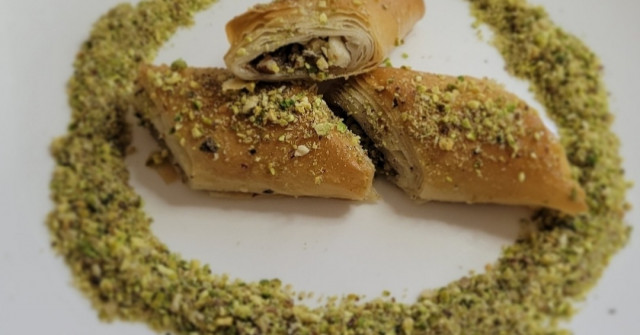
Baklava
Baklava is a multi-layered dessert made of thin sheets of buttered phyllo dough, layered in a rectangular baking pan or rolled into a tube shape. Filled with various kinds of nuts or ground pistachios with cinnamon, the pastry is soaked in a syrup of sugar, lemon juice or honey, and spices with rose water.
In Turkish and Greek cuisine it is common to cut the baklava into triangles, squares or diamonds and serve. In Turkish cuisine it is also common to roll out the dough and cut it into rounds from which a rolled baklava is made, cut into cylinders soaked in syrup and called in Turkish "sarayliye" (Saray is the Sultan's palace).
To make rolled baklava (tube shape), brush five sheets of phyllo dough (each one separately), place the nut mixture on one side, then roll the dough into a tube and seal it tightly. Cut the baklava on a diagonal.
To make the baklava easier to handle before cutting, it is advisable to place it in the freezer for 10-15 minutes.
After baking, whether it is rectangular or rolled baklava, pour the syrup over it (water and sugar in a one-to-one ratio, cooked together until thick, and then add a little lemon juice or honey with cinnamon and clove)
The pastry can be frozen.
It is hard to trace the origin of baklava, since every ethnic group whose ancestors came from the Middle East claims the pastry as its own.
It is assumed that the Assyrians invented baklava around the 8th century BCE, when several layers of thin bread dough were laid together, with chopped nuts between the layers, honey was added, and it was baked in a primitive wood oven. This version of baklava was baked only on special occasions.
In fact, baklava was considered food of the rich in the 19th century. In Turkey, until today, one can hear a common expression of the poor, or even of the middle class, saying: "I am not rich enough to eat baklava and borek every day".
Greek sailors and merchants who travelled east to Mesopotamia quickly discovered the delight of baklava. They brought the recipe to Athens. The great contribution of the Greeks to the development of this pastry was the creation of a dough technique that allowed it to be rolled as a thin leaf, compared with the coarse, bread-like dough texture of the Assyrians. In fact the name "phyllo" was coined by the Greeks, and means leaf in Greek. Within a relatively short time, in every well-off household kitchen in the region, trays of baklava were baked for all kinds of special occasions from the 3rd century BCE onward. The Armenians, whose kingdom was located on the Silk and Spice Road, were the first to combine cinnamon and clove into the baklava mixture. The Arabs were the first to introduce rose water and cardamom. The flavor changed in subtle differences as baklava began to cross borders. In the north of its birthplace, baklava was served in the palaces of ancient Persia. In the west, it was baked in the kitchens of wealthy Roman estates, and then in the kitchens of the Byzantine Empire until its fall in 1453 CE.
In the 15th century CE, the Ottomans advanced west into Constantinople, expanded their eastern territory and covered most of the ancient Assyrian lands and the entire Armenian kingdom. The Byzantine Empire came to an end, and the eastern Persian kingdom lost its western provinces to invaders. For four hundred years, from the 16th century onward, until the decline of the Ottoman Empire in the 19th century, the palace kitchens in Constantinople became the ultimate culinary center of the empire.
The artisans and experts of all the guilds, the bakers, cooks and pastry chefs who worked in the Ottoman palaces, in the estates of the pashas and viziers, in the residences of provincial governors and so on, had to be recruited from the various ethnic groups that made up the empire. Armenian, Greek, Persian, Egyptian, Assyrian and occasionally Serbian, Hungarian and even French chefs were brought to Constantinople to work in the kitchens of the wealthy. These chefs contributed greatly to the interaction and refinement of the art of cooking and pastry-making of an empire that covered a vast area including the Balkans, Greece, Bulgaria, Yugoslavia, Persia, Armenia, Iraq and all of Mesopotamia, Palestine, Egypt, North Africa and the islands of the Mediterranean and the Aegean. At the end of the 19th century, small pastry shops began to appear in Constantinople and the provincial capitals, to serve the middle class, but the Ottoman palace always remained the best culinary "academy" in the empire, until its end in 1923.
The special reason why baklava was the best pastry choice for the Turkish sultans with their large harems is that its ingredients were considered aphrodisiacs: pistachios and honey when taken regularly, and the spices: cinnamon for women, cardamom for men and clove for both sexes.
From the 18th century onward, almost nothing more was added to baklava, which was already perfect in texture and taste. Only a few cosmetic changes were made, in the shape and presentation of the baklava on the baking tray.
The Recipeat app
All the community's recipes in your pocket. Available now on Android.
Get it on Google PlayWant an email when a new recipe is posted?
About us
Recipeat is a social recipe site. It holds the recipes we all share, and every recipe you add goes straight into your own recipe book.
Read more