
Potjie
Cooking in a Potjie Pot
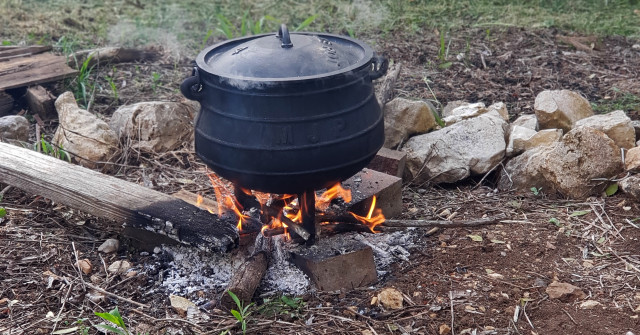
In 1662, the poyke, a cast-iron pot, was brought to Africa from Europe. The locals adopted it and used it as a cooking vessel in field conditions. In Afrikaans it is written as potjie, but in practice it is pronounced poy-kee-kawse, meaning "food from a pot".
The potjie is made of thick cast iron, with a rounded shape, supported on three legs. These features cause the heat to spread evenly over the entire surface of the pot and allow slow cooking or roasting, which gives the food a unique taste and aroma
The potjie can be a substitute and a variation on the familiar barbecue, except that patience is required here, because the cooking takes time: from our personal experience, at least four hours. So it's worth preparing the food before you feel hungry, right after breakfast, so that it's ready for lunch.
First use of the potjie pot
Fill the potjie with hot water and wash its inside with a little dishwashing liquid. Also the lid.
Dry the potjie and the lid thoroughly with a clean cloth.
Grease the inside of the pot and the lid with cooking oil: a thin layer applied with paper towel soaked in oil.
Heat the potjie and the lid in the oven (at 180 degrees) or over embers, until the oil is hot and just starts to smoke. Important! Avoid scorching the pot's protective coating.
The pot is now ready for use.
While cooking, place glowing embers under and around the pot. You can regulate the heat by moving the embers closer or farther away. Listen to your potjie's sound! If from a distance of 2 m you can hear a strong bubbling (boiling), the heat is too high. If you can barely hear a gentle simmer, the temperature is right.
It is recommended to light a fire on the side to create a constant supply of glowing embers. Do not cook over flame, only over embers.
The pot is made of cast iron, which stores the heat within it. To keep the food from burning, it is important to maintain a constant temperature throughout the cooking time. Always start cooking with a hot pot.
It is not advisable to use embers from treated wood soaked in chemicals; the chemicals spoil the special aroma of the food.
Cooking in a potjie requires patience: the less you open the pot and the less you stir, the better. If you stir, use a round spoon and stir close to the pot's wall so as not to crush the stew.
Heat the pot over embers for a few minutes.
Heat a little oil.
Add the onion and garlic and sauté for a few minutes.
Add the meat to "seal" it, to keep it juicy, stirring constantly with a long wooden spoon.
Add liquids to taste - wine, soy sauce, coconut milk, water - until they reach three-quarters of the pot's height.
Add spices and bring to a boil.
After half an hour, add coarsely chopped root vegetables (potatoes, carrots, kohlrabi, turnips, celery root) and legumes soaked overnight.
You can also add wheat at this stage.
About an hour before the end of cooking, add soft vegetables such as sweet potato and zucchini. And also rice.
From time to time, check the water level in the pot; it should be at least a third of the pot's height. If there is excess liquid, leave the pot open until it reduces.
Potjie at home
The potjie with its legs stands steadily over the stove, a few centimeters above the flame, and is suitable for cooking on gas burners.
Place the potjie over the gas flame and heat it until it begins to smoke slightly.
Prepare the stew according to the instructions above.
The whole stew should initially be covered with liquid, and if needed, top up what's missing with hot water. Bring to a boil and continue cooking for about 45 minutes to an hour over low heat. Cover the pot with its lid and listen to the sound of the pot: the bubbling should be slow and gentle. If the bubbling is fast and agitated, lower the flame to minimum or move the pot to a smaller flame.
Empty the oven completely of trays and racks
Heat the oven to about 160 degrees.
It is recommended to leave only one tray on the oven floor, on which you place the pot, so it's easier to put the heavy, hot potjie in and take it out of the oven by pulling and pushing the tray.
At this stage, before putting the potjie in the oven, it is recommended to taste and adjust the seasoning if needed. At this stage the vegetables are already starting to soften, so avoid stirring to not crush them.
Check the amount of liquid in the pot; it's recommended to have at least half the pot's height before transferring to the oven.
Continue slow cooking in the oven for another hour to an hour and a half, or until the meat is tender enough and the vegetables are soft enough to your taste.
The liquids should reduce to a rich, thick sauce.
Cleaning the pot
If there is a layer of burnt food, soften it with hot water and soap, and do not scrape with a sharp tool or steel wool so as not to damage the pot. After rinsing, it is important to dry the pot and lid and grease them with a thin layer of oil to protect against rust.
Our recipe
Basically, anyone can prepare it to their personal taste: meat, chicken or vegetarian. Decide which vegetables and spices you like. We usually prefer chicken and vegetables we have at home. Dark green pepper adds good flavor. We usually add whole onions, which become very soft during cooking and very tasty. Whole garlic cloves. Wheat or groats.
Put the meat and hard vegetables such as carrots, kohlrabi and potatoes into the pot, add water (we don't fry anything beforehand), and also the wheat. Cook like this for about three hours, then add the spices and soft vegetables, such as sweet potato and zucchini. If you use rice, this is the stage to add it. Continue cooking for another hour, check that everything is soft and ready to eat. If there is excess liquid, leave the pot lid open to let the liquid evaporate. Total cooking time is at least four hours, can be longer but not shorter.
And the seasoning: two teaspoons of chopped ginger, 4 tablespoons of honey, a quarter cup of soy sauce, half a cup of dry white wine, a quarter teaspoon of black pepper, two teaspoons of ground coriander seeds, a teaspoon and a half of salt. Be careful with the salt, both because of the soy sauce and because the long cooking and reduction of liquids makes the food salty.
And a liter and a half of water for a 4-quart pot. We cooked food in the potjie several times, and after many attempts we arrived at this amount of water, so that on one hand the food doesn't burn and on the other hand it doesn't produce broth, as broth ruins the whole taste.
Note: there is a recommendation to line the pot with cabbage leaves to prevent the food from burning.
The Recipeat app
All the community's recipes in your pocket. Available now on Android.
Get it on Google PlayWant an email when a new recipe is posted?
About us
Recipeat is a social recipe site. It holds the recipes we all share, and every recipe you add goes straight into your own recipe book.
Read more