
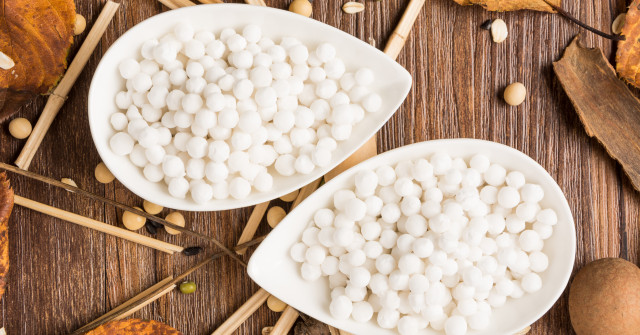
Tapioca
The root tuber, in some varieties sweet and in others bitter, has a thick brown skin, and its inner flesh is white.
Bitter and sweet cassava tubers are rich in calories, contain no significant amounts of vitamins and minerals, are very easy to digest, and are tasteless, so they can be used in a variety of ways.
Sweet tubers are eaten when fresh, and are consumed like potatoes.
Bitter tubers contain much more starch. In their fresh form they are toxic, so the tuber is peeled, the white flesh is grated, thoroughly rinsed, and the pulp is left to ferment slightly. The starch is then extracted, which goes through cooking, drying and grinding into a fine or coarse flour, into pure starch, or into the white granules that are tapioca.
When cooked, the white granules become translucent. They can be used to thicken soups, or as an addition to various dishes, and to prepare a sweet hot or cold pudding. In North America, eggs are added to the pudding, which makes it very thick and very heavy.
There are a few basic principles for making tapioca as a dessert:
Soak the tapioca in water for about two hours or overnight.
For every half cup of tapioca, use about three cups of liquid, depending on the desired thickness of the finished product.
The liquids can be water, milk, coconut milk, wine, juice and more.
You can sweeten it with sugar, honey, agave, date syrup, etc.
Then add flavors as your imagination allows: pomegranate concentrate, vanilla extract, rose water, coconut, almonds, cinnamon, cocoa, and more.
The Recipeat app
All the community's recipes in your pocket. Available now on Android.
Get it on Google PlayWant an email when a new recipe is posted?
About us
Recipeat is a social recipe site. It holds the recipes we all share, and every recipe you add goes straight into your own recipe book.
Read moreMeasurement converter
|
Ingredient |
Cup |
Tablespoon |
Teaspoon |
|---|---|---|---|
|
Powdered sugar |
120 g |
8 g |
3 g |
|
Chopped nuts |
100 g |
6 g |
|
|
Finely ground nuts |
85 g |
|
|
|
Rice |
200 g |
|
|
|
Honey |
360 g |
22 g |
7 g |
|
Butter Melted butter |
240 g |
15 g 14 g |
|
|
Peanut butter |
250 g |
|
|
|
Raw tahini |
240 g |
|
|
|
Salt |
250 g |
20 g |
6 g |
|
Maple syrup |
240 g |
|
|
|
Liquids Water, orange juice, milk |
240 g 240 ml |
15 g 15 ml |
|
|
Nutella |
280 g |
|
|
|
White sugar |
200 g |
12 g |
4 g |
|
Packed brown sugar |
240 g |
15 g |
5 g |
|
Semolina |
200 g |
10 g |
|
|
Can of condensed milk |
398 g |
|
|
|
Can of coconut milk |
400 g |
|
|
|
Cookie crumbs |
110 g |
|
|
|
Dry breadcrumbs |
125 g |
|
|
|
Chopped dried fruit |
150 g |
|
|
|
Ground poppy seeds |
70 g |
|
|
|
Coconut |
100 g |
|
|
|
Cornstarch |
140 g |
10 g |
|
|
White flour |
140 g |
10 g |
|
|
Whole wheat flour |
125 g |
8 g |
|
|
Cocoa |
140 g |
10 g |
|
|
Jam |
330 g |
|
|
|
Dulce de leche |
400 g |
|
|
|
Chocolate chips |
200 g |
|
|
|
Oats |
100 g |
|
|
|
Oil |
200 g |
|
|
|
Coconut oil solid melted |
|
14 g 14 g |
|
|
Oven temperatures Description |
Gas mark |
Celsius |
Fahrenheit |
|
Very low heat |
105 |
220 |
|
|
120 |
250 |
||
|
Low heat |
1 |
135 |
275 |
|
2 |
150 |
300 |
|
|
Medium-low |
3 |
160 |
320 |
|
Medium |
3 |
170 |
340 |
|
Medium |
4 |
180 |
355 |
|
5 |
190 |
375 |
|
|
Medium-high |
6 |
200 |
390 |
|
High |
7 |
220 |
430 |
|
8 |
230 |
445 |
|
|
Very high |
9 |
245 |
475 |
50 g fresh yeast (a "Shimrit" packet / cube) = 2 tablespoons dry
yeast. 1 tablespoon dry yeast = 10 g
To replace dry yeast with fresh yeast, multiply the amount by 3
1 g dry yeast = 3 g fresh yeast
Packet = 10 g
Tablespoon = 8 g
Teaspoon = 3 g
Gelatin packet = 14 g
Tablespoon of gelatin = 10 g
One gelatin sheet = 4 g
Gelatin packet = 3½ gelatin sheets
To dissolve 1 g of gelatin use 5 g
Egg size 1 (L) – 65 g and over
Egg size 2 (M) – 55-60 g
Egg size 3 (S) – 50 g
Egg white – 40 g on average
Egg yolk – 20 g on average
The oil should weigh 85% of the butter's weight
100 g butter = 85 g oil
200 g butter = 170 g oil
1 cup oil = 200 g
100 ml oil = 90 g
100 g butter = 100 g applesauce
100 ml oil = 100 ml applesauce
Replacing eggs with applesauce
1 egg = 60 g applesauce
Butter stick = 120 g, ½ cup
8 oz = 1 cup = 240 ml = 16 tablespoons
4 oz = ½ cup = 120 ml = 8 tablespoons.
2 oz = ¼ cup = 60 ml = 4 tablespoons.
1 oz = 2 tablespoons = 30 ml = ⅛ cup.
½ oz = 1 tablespoon = 15 ml = 3 teaspoons.
0.16 oz = 1 teaspoon = 5 ml = ⅓ tablespoon
1 pint = 480 ml = 2 cups.
1 quart = 960 ml = 4 cups.
A small package weighs 350 g
1 cup self-rising flour = 1 cup plain flour + 1 teaspoon baking powder
1 kg self-rising flour = 1 kg plain flour + 2 packets of baking powder